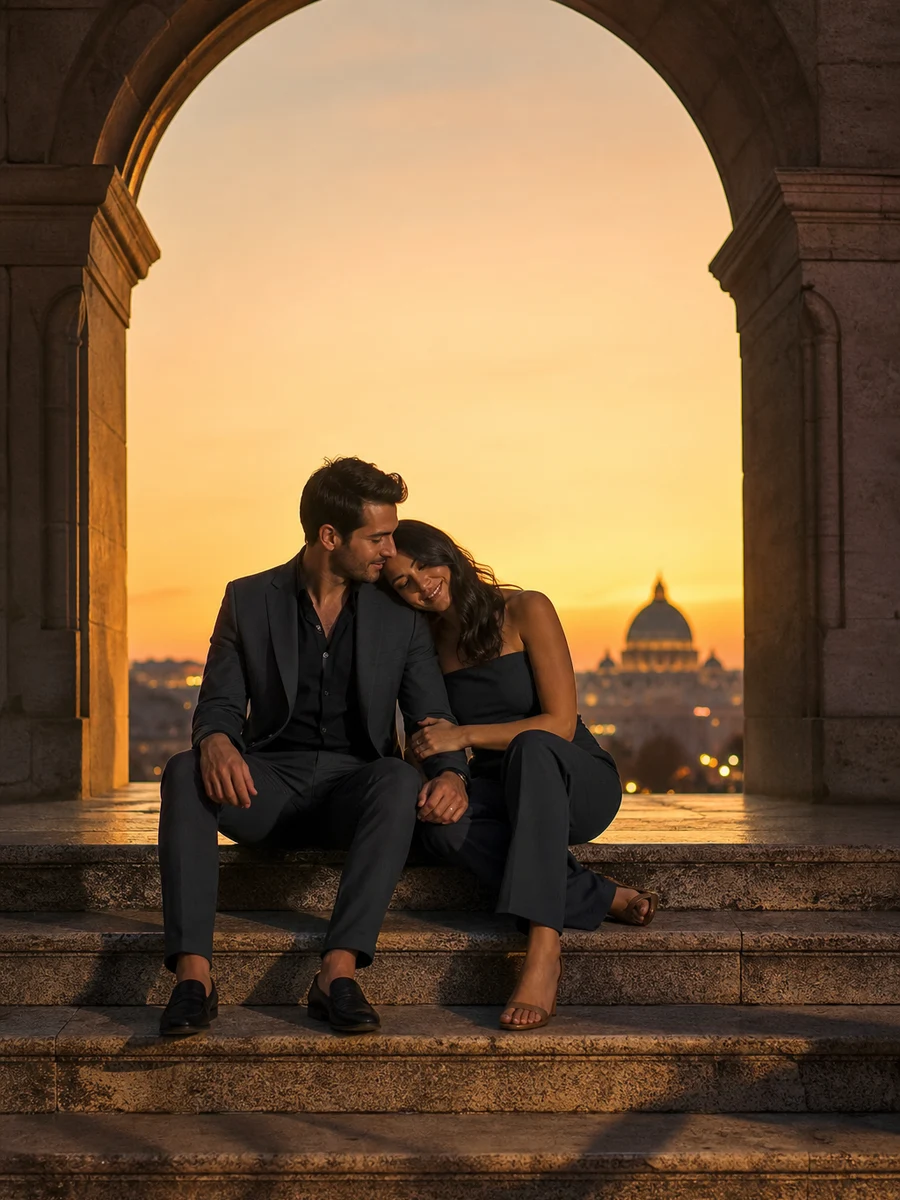
Sitting Close at the Top of the Stairs at Sunset Engagement Photos
Sunset on stairs: have them sit just as the light turns golden. The contrast between the warm couple and cool stone makes a visually intimate frame.
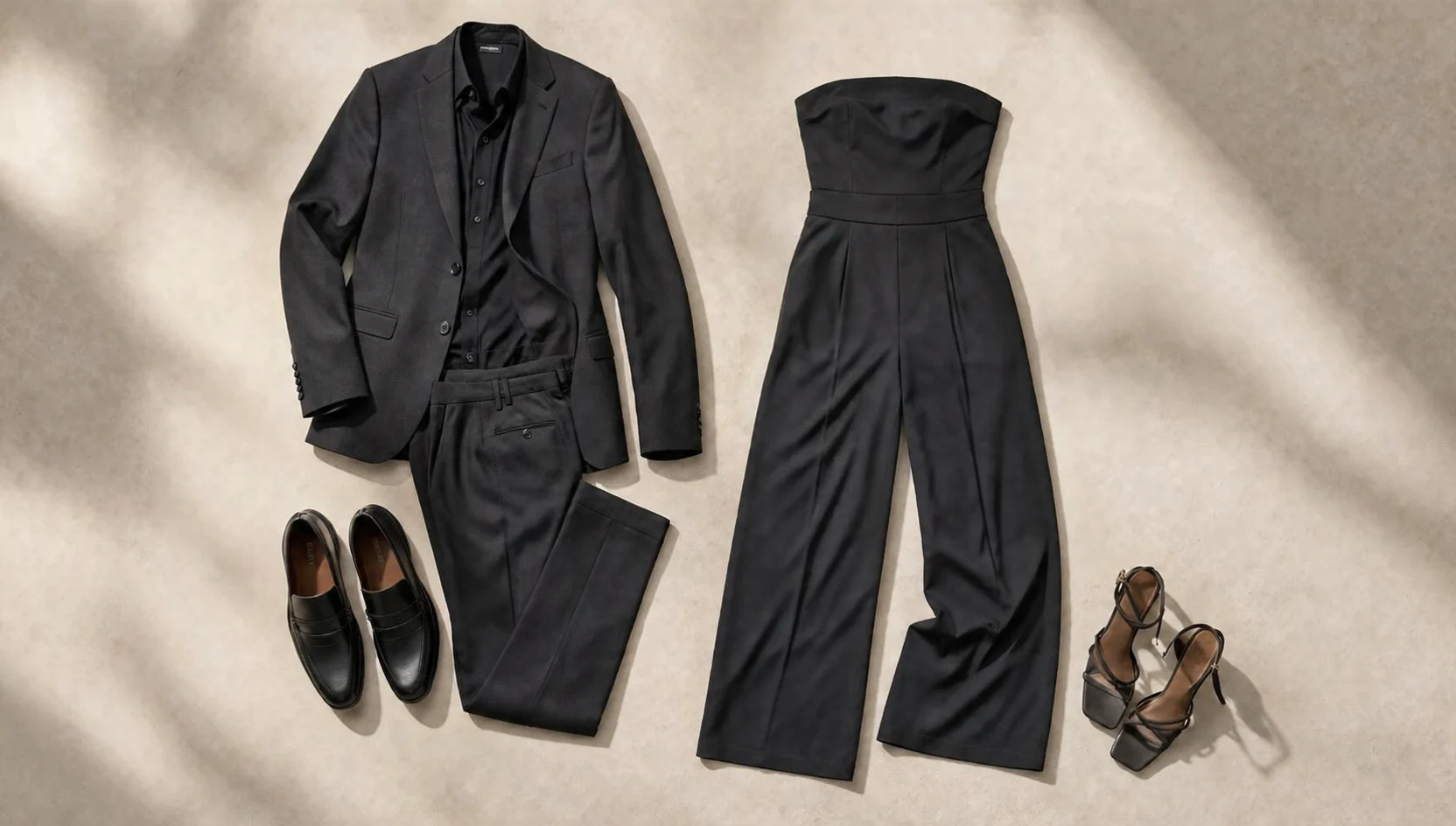
Outfit Ideas

He
suit
charcoal
She

Sunset on stairs: have them sit just as the light turns golden. The contrast between the warm couple and cool stone makes a visually intimate frame.

He
suit
charcoal
She
strapless jumpsuit
charcoal
You climb the last stone steps as the sun dips below the roofline. Your shoes scuff the treads, and the air smells of cooling pavement and far-off food carts. The archway frames the western sky, still streaked with a last blush of gold. You’re in charcoal and black — simple, sharp — her cashmere wrap clinging to your shoulder. You settle onto the top stair, the stone cool through your slacks. She leans into you, her head finding the hollow of your shoulder. Your hands lace together on your knee, a single knot against the evening chill. Below, the city starts to murmur with early evening traffic; a siren wails a dozen blocks away, barely a ripple. The photographer moves into the arch’s shadow, murmuring about the light. For twenty minutes, the sky deepens from tangerine to indigo, and one by one, the streetlamps flicker on. The archway becomes a silhouette, the city a constellation of warm dots. You don’t need to move much — just breathe, adjust a hand, press closer when a breeze kicks up. These city engagement photos aren’t about grand gestures; they’re about the quiet weight of her on your shoulder, your thumb tracing her knuckles. By the time the sky goes truly dark, you’re both reluctant to rise. You’ll walk away with frames that feel like you paused the city for just long enough.
🌆 Blue Hour — Shoot in the ~20 minutes after sunset when city lights glow against a deep blue sky.
The blue hour — those 20 minutes right after sunset — gives you the richest light for city engagement photos. The sky deepens to a vivid blue while streetlights, storefronts, and car headlights start to glow, creating a balanced mix of cool and warm tones. No harsh shadows, no squinting. Just before this, the last 30 minutes of golden hour wrap you in soft, directional light that adds warmth and dimension. If you schedule your session to cover both, you get a full arc of moody, cinematic frames.
It depends entirely on where you’re shooting. Public sidewalks and most city streets are fair game for casual, non-obstructive photography, but some plazas, parks, or landmark steps may require a permit for a professional shoot — especially if you’re using lighting equipment or blocking access. Check the city’s film office website or call 311 well ahead of time. If you’re eyeing a private archway or a residential stoop, get permission from the building owner. Your photographer will usually know the local rules.
Pick a weekday evening rather than a weekend, and scout your spot ahead of time. The top of a less-traveled staircase or a residential side street will have far fewer eyes than a main plaza. Arrive about 30 minutes before golden hour to claim your space and settle in. Your photographer can use angles — shooting from a low stair, framing tight on you two — to crop out passersby. A little patience goes a long way; wait a few seconds for a gap in foot traffic and you’re clear.
Stick to a tight, monochrome palette — charcoal, black, deep gray — to keep the focus on your expressions and the architecture. Skip busy patterns, logos, or big plaid, which can fight with the stone textures and city geometry. Lightweight layers give you flexibility as the evening cools: a fine merino sweater, a structured jacket. For her, a dark wrap or cardigan works perfectly. Comfortable but sleek shoes are non-negotiable; you’ll be sitting on uneven steps, but you still need to climb them.
Most sessions run 90 minutes to two hours, which lets you hit a couple of nearby backdrops at different light stages. For a sunset-to-blue-hour stair shoot, you’ll want at least an hour on-site. Spend the first 15 minutes warming up near the arch, working through a few different angles, then flow into the seated poses as the light shifts. Don’t rush — the best frames often come in the last minutes when you’ve forgotten the camera is there.
Rain doesn’t cancel a city shoot — it transforms it. Wet streets double the city lights into soft puddles of reflection, and misty air diffuses the glow beautifully through blue hour. Bring a clear or black umbrella (no logos) and a second layer you don’t mind getting damp. Your photographer will look for overhangs to shield gear, and you’ll get a moody, intimate set of engagement photos that nobody else has. If it’s truly storming, work with your photographer to reschedule — but drizzling is a gift.
During blue hour, you get a brief window where artificial light and the fading sky are nearly equal in brightness — something that never happens at noon. The backdrop turns into a deep, painterly blue, while streetlights and windows glow warm against it. Your faces aren’t blasted by sun; the light is even, soft, and directional from buildings. Daytime city shots feel crisp and energetic, but blue-hour frames carry a quieter, cinematic tension that feels more intimate and timeless.