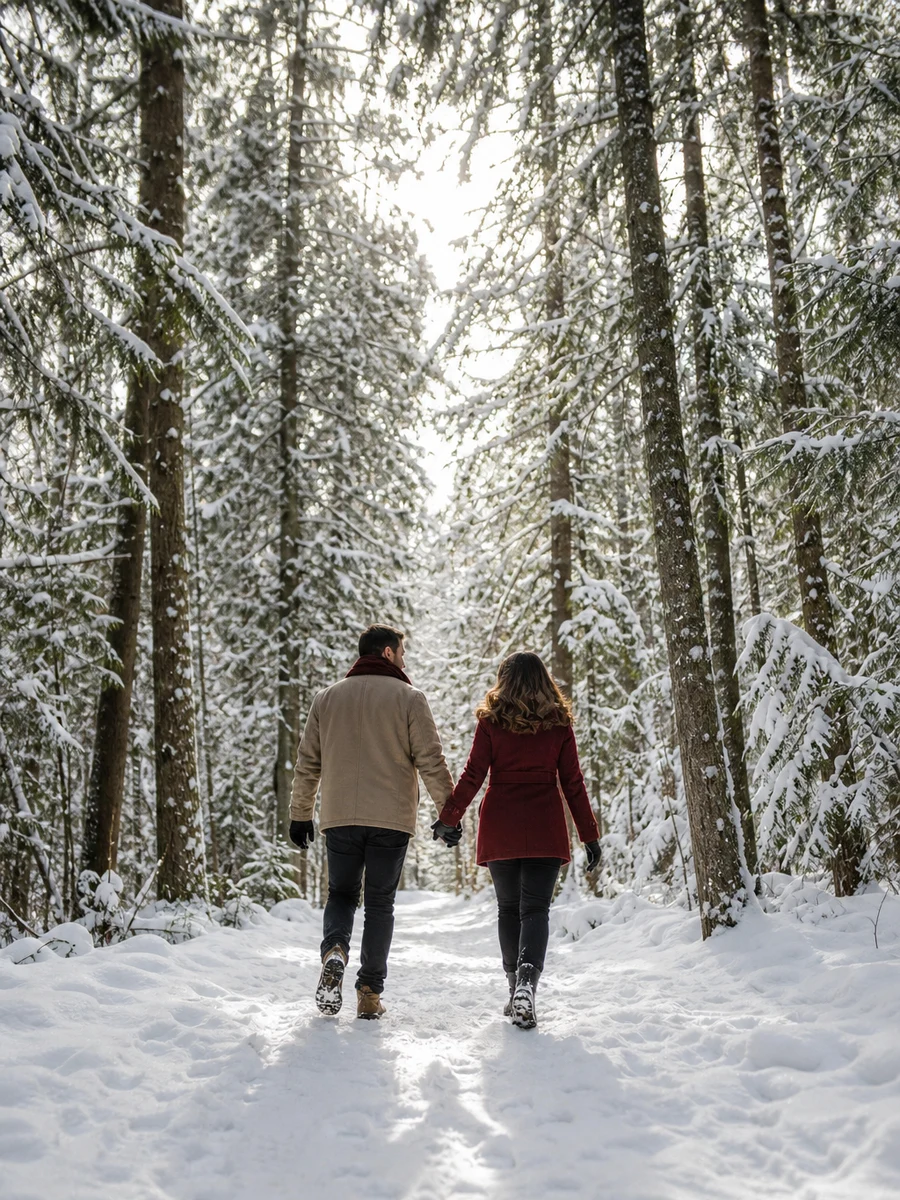
Strolling Together Through Snow-Dusted Pines Engagement Photos
Walk ahead and let the camera follow. Burgundy against snow creates a bold, romantic look.
📍 forest🍂 winter💑 walking-together
Outfit Ideas
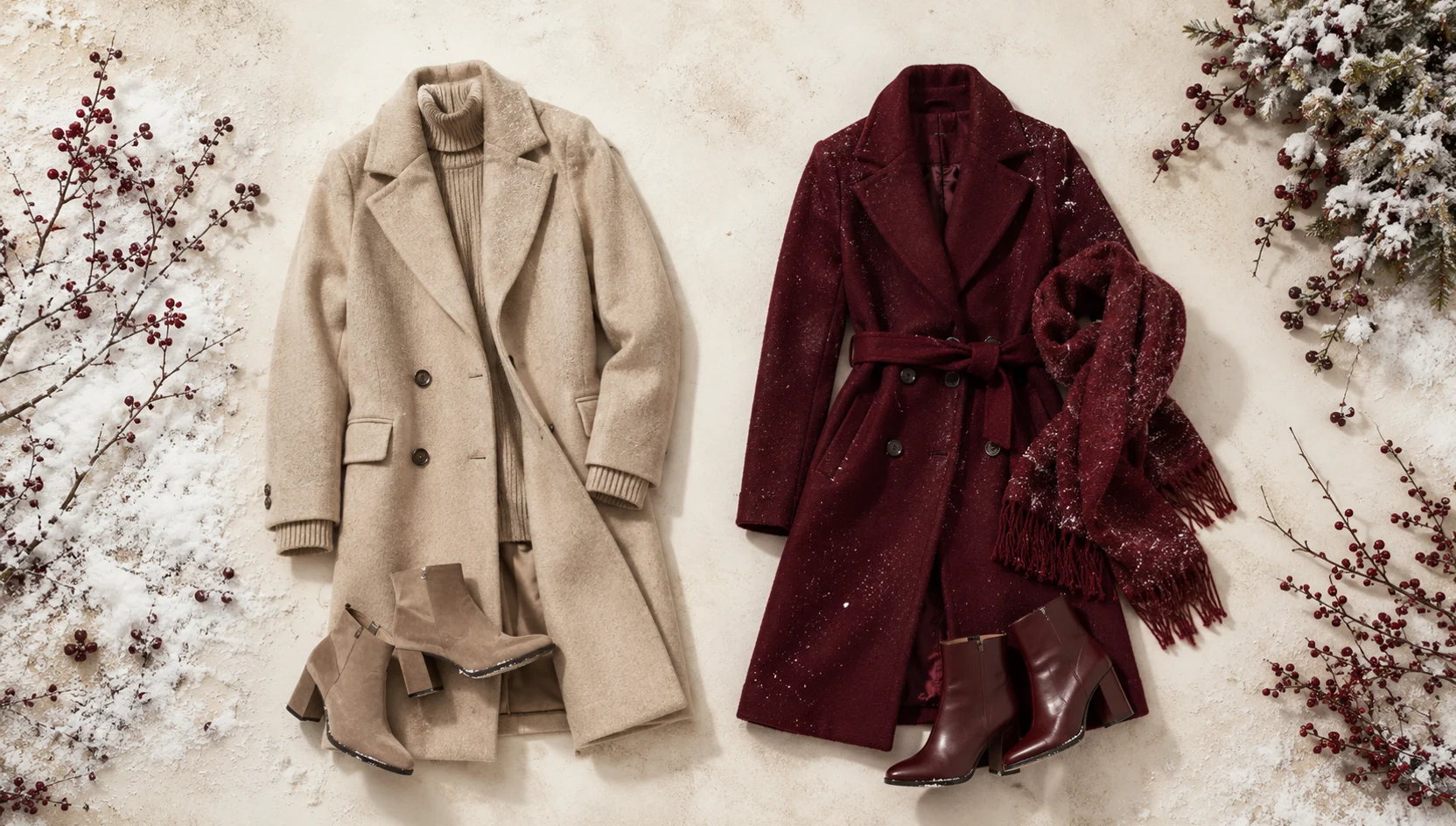
He
winter coat
beige
Walk ahead and let the camera follow. Burgundy against snow creates a bold, romantic look.
He
winter coat
beige
She
winter coat
burgundy
Your boots squeak and sink into the pristine snow as you step off the main path. It's early, not long after dawn, and the winter woods are hushed. The only sounds are the soft patter of snowflakes slipping from laden branches and the distant tap of a woodpecker. You pull your burgundy coat tighter — it’s a warm, rich slash of color that will leap out against this monochrome world. A scarf doubles as a prop: you can wrap it around both of you, or let it trail behind as you walk. The cold nips at your cheeks, turning them a natural pink, while the overcast sky acts like a giant diffuser. There are no harsh shadows, just a gentle, even glow that smooths skin and makes eyes sparkle. It's perfect light for forest engagement photos.
You start walking, hand in hand, along a narrow trail framed by towering pines. Their branches are frosted, bending low under the weight of last night’s snowfall. The photographer calls out: “When you reach that sunlit patch of snow — even on a cloudy day, there’s still a brightness — pause and glance back.” You do, turning just your upper body and looking over your shoulder toward the lens. The movement feels natural, a casual check to see if your partner is still smiling. That split-second of connection is what the lens captures. You’ll repeat this a few times, kicking up a little powder as you go, laughing when a clump of snow falls from a branch onto a hood. Because you arrived early, the trail ahead is an unbroken white blanket. Those fresh tracks you’re making become part of the story — evidence of a private adventure. For forest engagement photos, there’s nothing quite like that untouched landscape.
After an hour, your toes start to feel numb despite the grippy boots (essential for navigating icy patches under the snow). You head back toward the car, but not before one last shot: both of you sitting on a fallen log, hot thermos in hand. The steam curls against the gray sky. It’s a reminder that winter sessions are about rhythm — shoot, warm up, shoot. As you drive away, you’ll already be planning which prints go above the mantle.
☁️ Overcast — An overcast sky is a giant softbox — even, shadow-free light that flatters skin tones.
Start with thermal base layers—silk or merino wool—hidden under your outfit. This traps heat without bulk. Choose a stylish, well-insulated coat like your burgundy one, and add a scarf, hat, and gloves you can easily slip off for photos. Toasty hand warmers in pockets keep fingers nimble. Between shots, bundle up in a heavy parka. If you’re genuinely cold, your body will hunch and tense, so take frequent breaks in a warm car or with a thermos of tea. When you feel warm inside, your smile relaxes and your posture opens—that’s when you look most comfortable and natural.
In winter, bugs are essentially a non-issue; the cold puts ticks, mosquitoes, and biting flies into a dormant state. Your main concerns in a snowy forest are slips and hidden obstacles. Wear boots with deep tread or microspikes for grip, and tread carefully over what might be icy rocks or roots. It’s also wise to let someone know your location and expected return time, as cell service can be spotty. If you’re shooting in a managed forest, check for any trail advisories, but overall, a winter woodland is quiet and safe—just respect the cold and the terrain.
Search online for nearby state parks, national forests, or nature preserves with accessible trails. Look for recent visitor photos on social media or review platforms—this shows you the current tree cover and snow conditions. Pin-drop specific spots that offer a mix of open paths and dense pines. Ideally, scout the location a few days before your shoot, checking for parking, restroom access, and the walking distance to photogenic areas. A good forest for engagement photos has variety: a winding trail, a cluster of evergreens, maybe a fallen log or a small clearing. Avoid areas with heavy foot traffic so you’ll have that fresh, untracked snow.
It depends on the landowner. Public national forests generally allow recreational photography without a permit as long as you’re not setting up equipment, blocking trails, or conducting commercial shoots with a large crew. However, state parks or city-run nature areas often require a photography permit, even for small-scale sessions. Call the ranger station or check the official website before you go—some permits cost as little as $25 and guarantee you won’t be asked to leave. Private forests or arboretums almost always require permission. Sorting this out days in advance saves stress on shoot day and shows respect for the space.
An overcast winter day actually provides steady, diffuse light that’s easier to work with than harsh sun. Your photographer will likely use a wider aperture (like f/2.8 or lower) to let in more light, and may raise the ISO to maintain a fast shutter speed—typically 1/200 or faster to freeze slight movement like walking or laughing. If the forest is very dense and dark, they might introduce a small LED panel or off-camera flash to add a catchlight in your eyes without overpowering the scene. Trust your photographer to balance exposure settings; your job is to stand still during key shots when asked, especially in dimmer pockets under heavy tree cover.
On an overcast day, you have a wider window of good light compared to sunny days. Since the clouds diffuse light evenly, you can shoot from mid-morning to mid-afternoon without harsh shadows. However, winter days are short. Aim to start about two hours after sunrise, giving you soft, bright light that filters through the pines. By 3 p.m., the forest can begin to darken quickly, so plan a 90-minute session ending before twilight. If you want the ethereal glow of snow reflecting a low sun, an overcast sky might not cooperate, but the trade-off is consistent, flattering light for the entire shoot.
Quite the opposite—it’s a gift. An overcast sky acts like a giant softbox, wrapping light around you and eliminating harsh facial shadows, shiny foreheads, and squinting. In a snowy forest, the white ground acts as a natural reflector, bouncing light upward and giving you a clean, bright look. Colors—especially that burgundy coat—appear richer and more saturated without direct sun competing. Your skin tones stay even, and the mood becomes intimate and cozy. The only downside? The sky itself may appear a flat gray in wide shots, but your photographer can compose to minimize sky or use it as a minimalist, wintry backdrop.